Sylvia

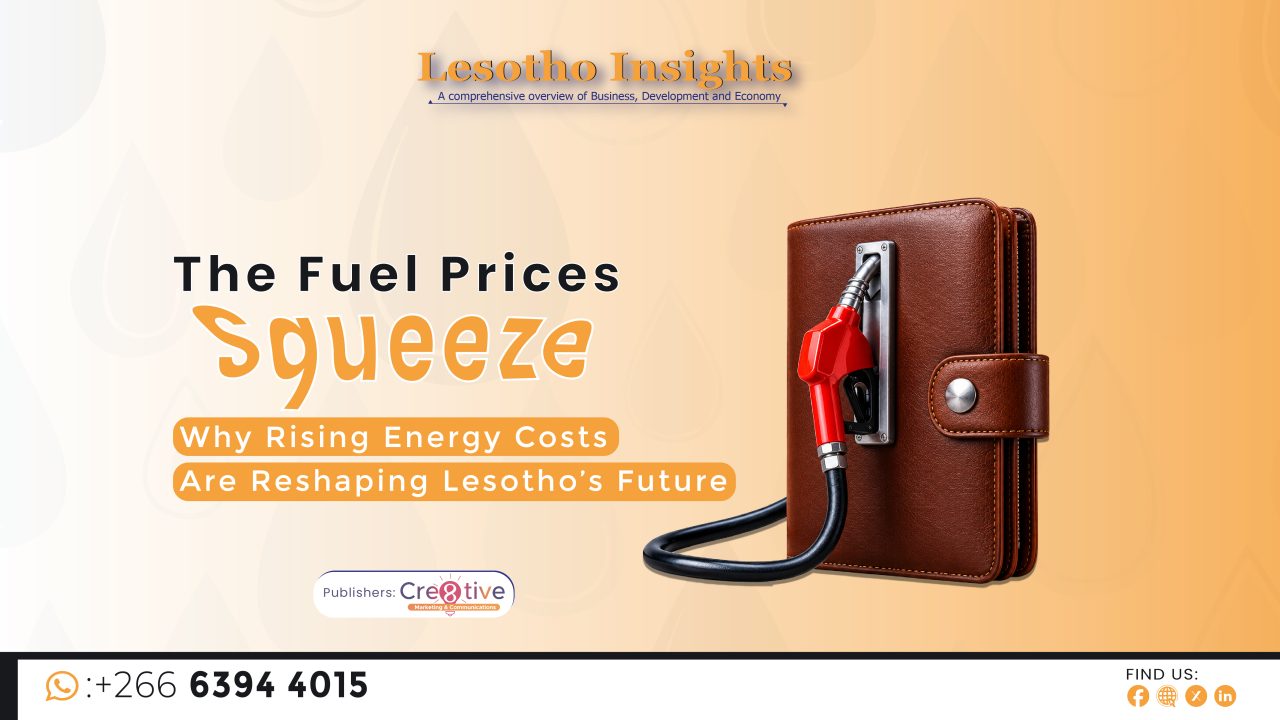
The Fuel Price Squeeze: Why Rising Energy Costs Are Becoming Lesotho’s Defining Economic Challenge

By Moeketsi Mots’osi
Executive Summary
Fuel prices rarely dominate public debate for long. They rise, consumers complain, businesses adjust, and policymakers search for temporary relief measures. Yet there are moments when energy costs cease to be a routine economic issue and become a defining strategic challenge. Lesotho is approaching such a moment.
The latest fuel price increases are occurring against a backdrop of heightened geopolitical uncertainty, elevated global energy costs, renewed inflationary pressures, and a global economy increasingly divided between countries that produce energy and those that consume it. The challenge for Lesotho is particularly acute because it possesses little direct influence over the forces determining the price paid by motorists, businesses, and households. As an import-dependent economy whose fuel supply is closely linked to South Africa’s energy market, Lesotho effectively imports inflation whenever oil markets become volatile.
What appears at first glance to be a petroleum issue is increasingly becoming a broader economic challenge with implications for inflation, growth and living standards. According to data published by the Petroleum Fund, Petrol 95 sold for approximately M19.35 per litre in October 2025. By October 2026, the same litre cost M28.60, representing an increase of M9.25 per litre or nearly 48% within twelve months. Diesel prices rose even more sharply, reaching M34.90 per litre in October 2026. This surge substantially outpaced growth in household incomes and economic output over the same period, transforming fuel costs into one of the most significant drivers of inflationary pressure in the economy. Every increase at the pump reverberates through supply chains, raising the cost of transporting goods, producing food, operating businesses and providing public transport services. In an import-dependent economy such as Lesotho, where virtually every productive sector relies on road transport, a near-50% rise in fuel prices within a single year represents more than a temporary market fluctuation. It signals a structural vulnerability that is eroding household purchasing power, undermining business competitiveness and increasing the economy’s exposure to external shocks originating far beyond the country’s borders.
A New Global Energy Reality
For much of the previous decade, policymakers became accustomed to a world characterised by relatively benign inflation, stable supply chains, and abundant energy. That environment has largely disappeared. Energy has once again become a central determinant of economic performance, inflation outcomes, and geopolitical influence.
Global oil markets remain vulnerable to disruptions stemming from conflicts, trade tensions, and supply chain bottlenecks. Recent concerns surrounding the Middle East, including uncertainty regarding major shipping routes and oil transit corridors, have contributed to increases in crude oil prices and transportation costs. The result has been renewed pressure on inflation across both advanced and developing economies.
The International Monetary Fund now warns that energy-importing economies face some of the greatest vulnerabilities in the current global environment. While economic growth remains resilient, inflation has proven more persistent than many central banks anticipated, forcing policymakers worldwide to reconsider the assumption that price stability had been successfully restored.
For a country such as Lesotho, the implications are profound. Unlike major economies that possess strategic petroleum reserves, diversified energy networks, or domestic oil production, Lesotho functions largely as a price taker. It absorbs global shocks rather than shaping them.
In economic terms, this leaves the country exposed at precisely the moment when energy markets have become one of the world’s most important sources of uncertainty.
Why Every Fuel Price Increase Matters More in Lesotho
The impact of rising fuel prices is magnified in smaller economies that depend heavily on imports. In Lesotho’s case, the dependence is structural rather than cyclical.
Virtually all petroleum products consumed within the country are sourced through South Africa’s supply chain, meaning developments in global oil markets and South African fuel pricing mechanisms quickly filter into the domestic economy.
This dependence creates a chain reaction that extends far beyond energy consumption itself.
When fuel becomes more expensive, transportation costs increase. Higher transport costs raise the price of distributing food, construction materials, agricultural inputs, and consumer goods. Businesses facing rising operational costs attempt to protect margins by increasing prices. Consumers consequently experience a deterioration in purchasing power.
The process is both predictable and relentless.
A litre of fuel purchased in Maseru ultimately influences the price of bread in Mokhotlong, the cost of transporting produce from agricultural areas, and the operating expenses of virtually every enterprise in the economy.
This interconnectedness explains why fuel price increases carry disproportionate economic significance. Energy serves as a foundational input into economic activity. When its cost rises, the effects are transmitted across multiple sectors simultaneously.
Unlike many economic shocks that affect one industry at a time, fuel inflation affects almost everything.
The Household Consequences: An Invisible Reduction in Living Standards
For ordinary Basotho, rising fuel prices resemble a silent tax on economic wellbeing.
Households may not purchase large quantities of fuel directly, but they consume its effects every day. Public transport fares rise. Food prices increase. Utilities become more expensive. Services cost more. Disposable income declines.
The burden falls most heavily on lower and middle-income households because essential expenditures consume a larger proportion of earnings. Wealthier households can often absorb higher transport or food costs without significantly altering their lifestyles. Lower-income households possess far less flexibility.
This reality makes fuel inflation particularly damaging from a social perspective.
A sustained increase in transport costs restricts access to employment opportunities. Higher food prices increase pressure on family budgets. Businesses become more cautious about hiring workers or increasing wages. The combined effect is a gradual erosion of living standards even if headline economic indicators remain relatively stable.
Many households experience the effects long before they appear in official economic statistics.
That is why fuel prices frequently become a political issue. Citizens understand intuitively what economists later confirm analytically: sustained energy inflation reduces economic welfare.
The Inflation Problem Policymakers Cannot Ignore
Inflation has re-emerged as one of the defining economic concerns of the post-pandemic era, and fuel prices remain among its most powerful drivers.
The recent fuel adjustments in Lesotho have reinforced concerns about rising costs throughout the broader economy. Because fuel influences transportation and production expenses across nearly every sector, increases often trigger secondary rounds of price increases that persist long after the initial shock.
This places policymakers in an uncomfortable position.
Attempting to shield consumers through subsidies can provide immediate relief but often creates fiscal strain. Allowing prices to adjust fully preserves market efficiency but exposes households and businesses to greater economic hardship.
The debate is not unique to Lesotho. Around the world, governments are grappling with similar trade-offs. The International Monetary Fund has argued that policymakers should preserve price signals while targeting support specifically toward vulnerable populations rather than attempting to suppress market forces entirely.
The logic is straightforward. Artificially low fuel prices may reduce immediate pain, but they do little to address underlying vulnerability.
Economic resilience is ultimately created through adaptation, not insulation.
Business Competitiveness in an Era of Expensive Energy
For corporate leaders, fuel prices have evolved from an operational consideration into a strategic variable.
The traditional response to higher energy costs has been cost containment. Increasingly, however, that approach is insufficient. Persistent fuel inflation is fundamentally changing the economics of transport, manufacturing, agriculture, mining, and retail.
The most successful organisations are therefore focusing less on absorbing higher costs and more on redesigning business models around energy efficiency.
Across global markets, companies are investing heavily in supply chain optimisation, predictive analytics, automation, and artificial intelligence. These technologies enable firms to reduce fuel consumption, optimise logistics networks, and improve operational productivity.
In effect, technology is becoming a hedge against energy inflation.
The businesses most likely to outperform over the next decade will not necessarily be those paying the lowest fuel prices. They will be those that generate the highest economic output for every unit of energy consumed.
For Lesotho’s private sector, this distinction is becoming increasingly important.
Competitive advantage is shifting from access to resources toward the intelligent use of resources.
Investment Opportunities Hidden Within the Crisis
Periods of economic disruption often create opportunities that remain invisible during more stable times.
While rising fuel prices undoubtedly present risks, they also accelerate investment themes that may shape the next phase of economic development.
Renewable energy is perhaps the most obvious example.
As fossil fuel prices become more volatile, the economic case for alternative energy sources strengthens. Solar, hydropower, battery storage technologies, and energy-efficient infrastructure become increasingly attractive investments.
Lesotho enters this transition from a position that is more favourable than many assume.
The country’s hydroelectric capabilities, particularly through the Lesotho Highlands Water Project, provide a foundation upon which broader energy security strategies can be built. Over time, additional investment in renewable generation could reduce dependence on imported energy while supporting industrial development.
The strategic question is no longer whether the global economy will transition toward cleaner energy systems.
The question is which countries position themselves early enough to benefit.
Those that remain dependent on imported energy risks may discover that competitiveness becomes increasingly difficult to sustain.
From Fuel Management to Economic Resilience
Perhaps the most important lesson from recent energy shocks is that fuel pricing is not the real issue.
Dependence is.
Countries that repeatedly find themselves vulnerable to fuel price increases are often confronting a deeper structural challenge: excessive reliance on imported energy and limited economic adaptability.
For Lesotho, the long-term policy response should therefore extend beyond monthly fuel pricing adjustments.
The larger objective must be resilience.
That means investing in local energy generation, improving public transport infrastructure, strengthening logistics networks, encouraging technological adoption, and enhancing productivity across the economy.
Such reforms require patience and political commitment. Their benefits may not be immediately visible.
Yet history consistently demonstrates that nations capable of reducing their exposure to external shocks ultimately achieve stronger and more sustainable growth.
The economic winners of the next decade are unlikely to be those fortunate enough to avoid disruption.
They will be those capable of adapting to it.
Looking Ahead: The Next Five Years
The outlook for global energy markets suggests continued volatility rather than a return to stability.
Geopolitical tensions remain elevated. Global supply chains continue to face pressure. Energy security has re-emerged as a strategic priority for governments worldwide. Meanwhile, the rapid expansion of artificial intelligence and digital infrastructure is expected to increase global energy demand even as technology improves efficiency and productivity.
For Lesotho, this environment requires a fundamental shift in thinking.
Fuel price increases should no longer be treated as isolated events. They should be viewed as signals of a broader economic transition taking place across the world economy.
Energy, technology, productivity, and resilience are becoming increasingly interconnected.
The countries that understand this relationship earliest will be best placed to thrive.
For Lesotho, the challenge is undeniable. Yet so is the opportunity.
The real economic story is not the price displayed at the fuel pump. It is whether the country can use today’s energy shocks as a catalyst to build a more productive, innovative, and resilient economy for the future.