Sylvia

Lesotho Attracts the Tourists. But Who Is Capturing the Money?
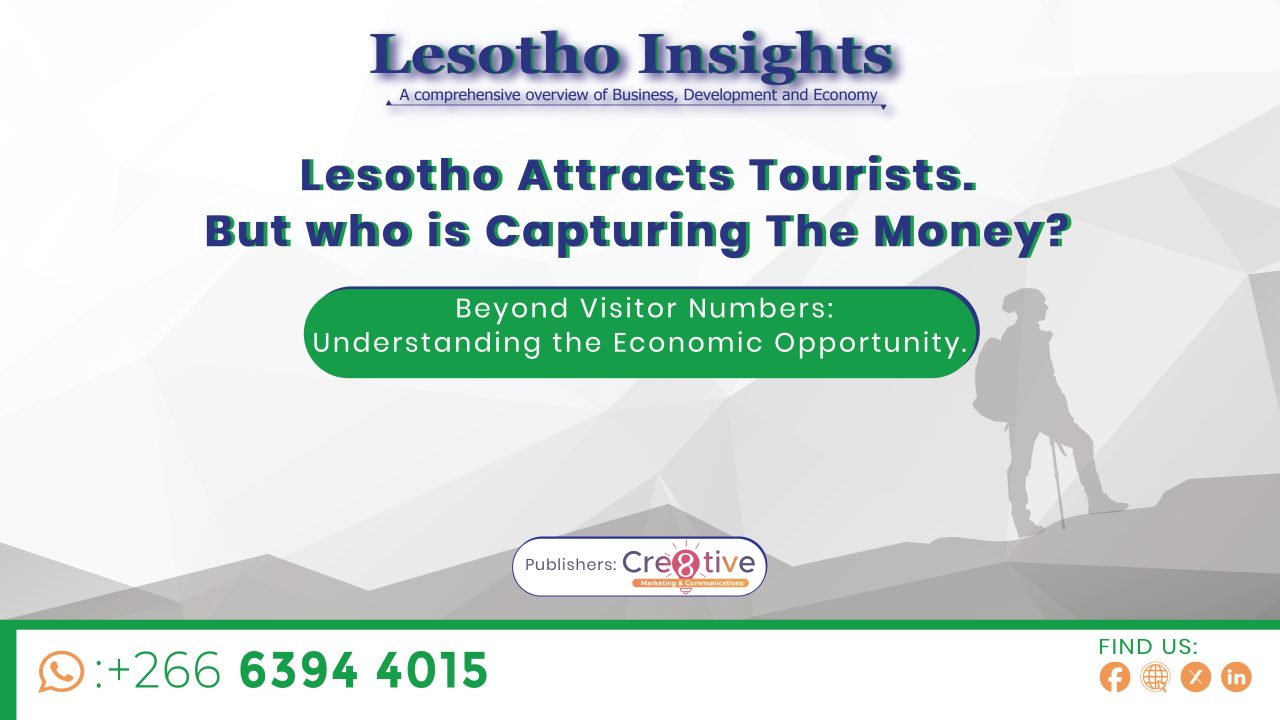
Lesotho Attracts the Tourists. But Who Is Capturing the Money?
Lesotho is attracting growing attention as a tourism destination, from its mountain landscapes and cultural experiences to internationally recognised events such as Roof of Africa, Lesotho Wine Fest as well as the ‘Maletsunyane Braai Fest just to name a few. The growing presence of African content creators and travellers showcasing the Mountain Kingdom offers another indication of the country’s destination-marketing potential.
As the festive season approaches, these events invite a broader economic question: are we building the businesses, infrastructure and visitor experiences needed to turn tourism attention into lasting economic opportunity for Basotho?
Attracting visitors is one achievement. Ensuring that their spending supports domestic enterprises, workers and host communities is another. The challenge is to strengthen the economic connections through which tourism demand translates into local livelihoods.
Beyond visitor numbers: understanding the economic opportunity
The Roof of Africa rally is an undeniable showcase of Lesotho’s landscapes and sporting tourism potential. The Lesotho Tourism Development Corporation (LTDC) reported that the 2025 event attracted over 400 riders from 15 countries, generating an estimated M8.71 million in local spending.
High visitor expenditure doesn’t automatically translate to local wealth. In development economics, economic leakage occurs when tourism revenues escape the destination rather than being reinvested locally. As Jönsson (2015) emphasizes, this happens when an ecosystem relies heavily on imported goods, external labour or foreign-owned operators. When a lodge imports supplies from across the border instead of buying from a local Mosotho farmer, that capital directly exits our economic cycle.
Lesotho’s National Tourism Master Plan (February 2019) identifies a gap between the country’s tourism potential and the economic value it captures. It reports that direct tourism receipts accounted for 1.5% of GDP in its baseline, while average direct expenditure was US$31 per visitor. The plan’s comparison with South Africa’s US$150 points to an opportunity to strengthen the value generated from tourism, although these figures alone do not explain why expenditure is relatively low or establish how much tourism income leaves Lesotho.
Conversely, the multiplier effect occurs when visitor spending stays within the community, generating secondary income as local suppliers pay wages and purchase domestic inputs. In fact, the NTMP projects that building solid internal value chains could unlock a tourism multiplier of two to three across the indirect economy. As discussed in UNCTAD’s Economic Development in Africa Report 2017, capturing this ripple effect requires deep domestic linkages. If the tourism ecosystem fails to integrate local food systems, crafts, and transport networks, some of that potential domestic economic activity occurs elsewhere.
Following the 2026 event, a discussion on social media questioned whether Basotho businesses were sufficiently positioned to sell food, beverages, ice, traditional attire and other essentials. Those concerns should not be treated as proof that sales opportunities were missed. They do, however, raise an important question: when tourism creates demand, which businesses are equipped to supply it?
The same question extends beyond a single rally. Festivals and other events can create demand for food, beverages, accommodation, transport, crafts and other services, but the scale of the opportunity depends on how effectively local businesses can access and supply that demand.
UNCTAD’s (2015) study of tourism linkages in the Lao People’s Democratic Republic identifies weak connections between tourism and domestic production, particularly agriculture, alongside the limited integration of local handicrafts into tourism supply chains. It also highlights opportunities to strengthen local participation through improved service quality, cultural excursions and more diversified visitor experiences. These findings underscore a broader economic principle: tourism’s development potential extends beyond visitor expenditure to the domestic industries, enterprises and workers connected to it.
Lesotho’s development challenge, therefore, is not simply to attract more visitors. It is to strengthen the connections between tourism and local producers, suppliers and service providers so that more of the resulting economic activity can support domestic livelihoods.
From destination marketing to domestic market mobilisation
Lesotho’s tourism promotion has an increasingly visible ambition: to position the Mountain Kingdom as a destination of choice. The corresponding economic question is whether domestic businesses are being mobilised with comparable reach and intensity to participate in the demand this visibility generates. Whether through sporting events, festivals or broader destination promotion, the ambition to attract visitors needs to be matched by a deliberate effort to mobilise domestic businesses.
The ambition should match the scale of the destination-marketing effort. If Lesotho is investing in making the country more visible to international visitors, local enterprise mobilisation should be an equally deliberate part of the strategy not an assumption that businesses will automatically benefit once visitors arrive.
This is consistent with LTDC’s stated mandate to facilitate a conducive environment for tourism businesses and support employment and economic growth (Lesotho Tourism Development Corporation, n.d.). The opportunity is to assess how effectively destination promotion is matched by domestic market mobilisation, and how participation can be measured across major events.
In practice, this means communicating trading opportunities early, publishing transparent vendor requirements, connecting event organisers with local suppliers and ensuring that smaller enterprises can understand and access the available opportunities. The objective is not simply to increase vendor numbers, but to strengthen the conditions under which Basotho businesses can respond to tourism demand.
A destination is only as strong as its wider visitor experience
Tourism value also depends on what happens beyond the main attraction.
A visitor’s video account of struggling to find food near the Katse resource centre raises questions about the visibility of services around tourism sites. One account does not establish a widespread problem, but it prompts us to ask whether visitors can easily find places to eat, sleep, refuel or access local guides. Strengthening the digital presence of local businesses, including through free tools such as Google Business Profile, could help bridge this information gap.
A business may exist but remain commercially invisible if its location, operating hours and contact details are difficult to find. Accurate digital listings and booking information can help connect potential customers with existing local services.
Physical access matters just as much. Disruptions along routes such as Moteng Pass can affect travel plans, visitor confidence and local earnings, particularly during winter tourism. Snow may attract visitors, but unreliable access can lead to cancelled bookings and lost income.
Roads, communications, electricity and visitor services are examples of complementary infrastructure: the systems that help turn an attraction into an accessible, viable tourism product. Promoting a destination without ensuring that visitors can find and reach the businesses around it risks creating opportunities that local enterprises are not equipped to capture.
Measuring value, not just visibility
Visitor arrivals and publicity measure a destination’s reach, but not how much economic value stays within local businesses and communities. Assessing this requires four measures: local procurement; vendor participation and revenue; local jobs and wages; and visitor spending and length of stay.
LTDC’s statistical reports provide a starting point for understanding tourism activity. Event-level data would help establish how much spending goes to domestic suppliers, how many local vendors participate and what they earn, how many jobs go to Basotho and what those jobs pay, and how much visitors spend and how long they stay.
These measures must also distinguish between businesses operating in Lesotho and those owned by Basotho. A business may operate locally without its ownership being domestic, while a Basotho-owned enterprise represents a more direct channel through which tourism income can accrue to local entrepreneurs. Tracking both would help establish not only where tourism activity takes place, but who owns the businesses capturing its value.
The findings would also help determine where intervention is needed. Limited local procurement may point to supplier-development gaps; low vendor participation or earnings may warrant a review of event trading arrangements; and short stays or low visitor spending may signal gaps in the wider visitor experience. Rather than assuming that tourism opportunities are being missed, evidence would help identify where barriers exist and whether the benefits of tourism are reaching domestic enterprises and communities.
The opportunity is bigger than the weekend
Roof of Africa, Maletsunyane Braai Fest and other events can contribute to a broader tourism economy when they connect visitors with local accommodation, food, transport, cultural experiences and nearby attractions. Their value should therefore be considered not only in terms of attendance and visibility, but also in the economic opportunities they create and the businesses and communities able to participate.
As Lesotho approaches the festive season, the opportunity is to connect individual events to a more coordinated tourism strategy one that supports domestic suppliers, improves visitor information and measures local economic participation.
Attracting tourists is a tourism achievement. Enabling Basotho to prosper from their presence is an economic development achievement.
For professionals working across tourism, hospitality, business development, local government and economic policy: what is the biggest missing link between attracting visitors to Lesotho and ensuring their spending generates broader domestic economic benefits, and what evidence should we collect to measure that gap?
References
Google. (n.d.). Get started with Google Business Profile. Google Business Profile Help. https://support.google.com/business/answer/7039811
Jönsson, C. (2015). Leakage, economic tourism. In J. Jafari & H. Xiao (Eds.), Encyclopedia of tourism (pp. 1–2). Springer. https://doi.org/10.1007/978-3-319-01669-6_527-1
Lesotho Tourism Development Corporation. (2019). National tourism master plan. Visit Lesotho. https://www.visitlesotho.org.ls/national-tourism-master-plan
Lesotho Tourism Development Corporation. (n.d.). Background. Visit Lesotho. https://www.visitlesotho.org.ls/background
Lesotho Tourism Development Corporation. (n.d.). Statistical reports. Visit Lesotho. https://www.visitlesotho.org.ls/statistical-reports
United Nations Conference on Trade and Development. (2015). Enhancing backward linkages between tourism and other sectors in Lao People’s Democratic Republic (UNCTAD/DITC/TED/2014/4). https://unctad.org/publication/enhancing-backward-linkages-between-tourism-and-other-sectors-lao-peoples-democratic
United Nations Conference on Trade and Development. (2017). Economic development in Africa report 2017: Tourism for transformative and inclusive growth (UNCTAD/ALDC/AFRICA/2017). United Nations. https://unctad.org/publication/economic-development-africa-report-2017