Sylvia
Lesotho’s 2025/26 Budget Speech
Lesotho’s 2025/26 Budget Speech: A Blueprint for Inclusive Growth and Structural Transformation
The budget speech is a statement of intent, a blueprint that guides government expenditure and policy direction for economic diversification. It also defines national priorities and fiscal prudence to secure the future. Presented to parliament, its goal is to build a more prosperous, equitable and competitive Lesotho.
The 2025/26 National Budget, tabled by the Minister of Finance and Development Planning, Dr. Retselisitsoe Matlanyane under the theme “Building Strategies for Inclusive Growth,” reflects Lesotho’s bold pivot toward a more resilient, equitable, and diversified economy. Amid evolving global uncertainties, Dr. Matlanyane presented a fiscal framework that balances macroeconomic stability with ambitious structural reforms. This budget signals critical shifts with far-reaching implications.
This budget analysis offers a deep dive into the government’s priorities, economic underpinnings, ministry-level allocations, and the broader implications for Lesotho’s development trajectory.
Economic Outlook: Resilience in a Volatile World
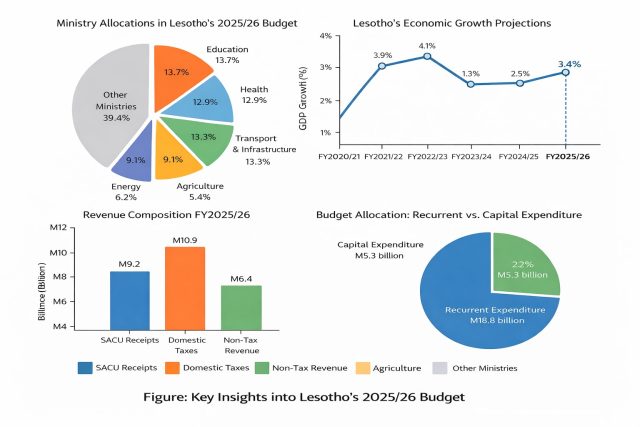
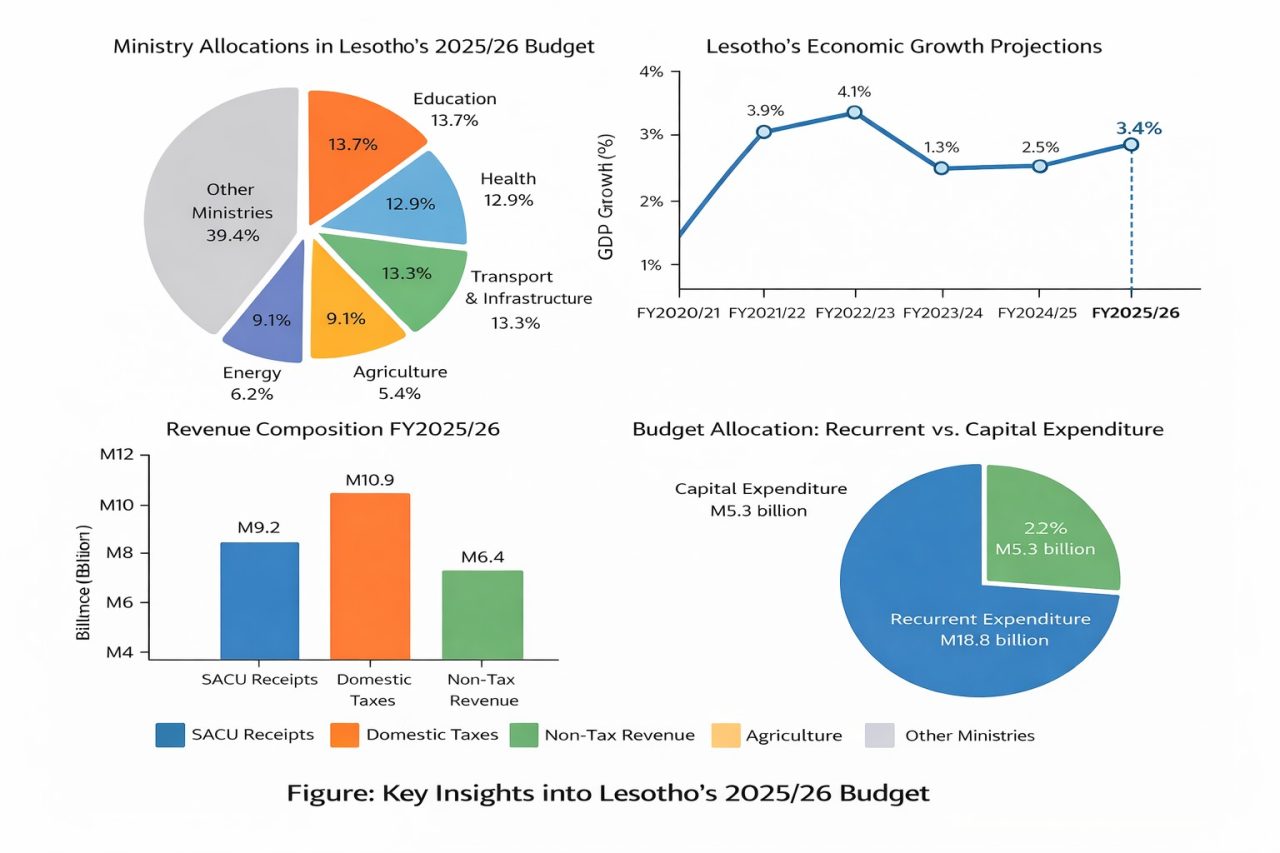
The 2025/26 budget is crafted against a backdrop of moderate global growth (IMF projects global growth at 3.3% for 2025), with Sub-Saharan Africa expected to grow at 3.8% in 2024 and 2025. Domestically, Lesotho’s economy grew 2.5% in 2024/25, buoyed by a 22.5% expansion in construction, and 3.7% growth in services. Agriculture was mixed, with animal farming up 3.5% but crop production down 5.1%, reflecting vulnerability to climate shocks.
In 2025/26, the economy is projected to grow by 3.4%, driven again by construction (forecasted at +30.4%), slight recovery in agriculture, and stable services. However, manufacturing (-4.2%) and mining (-2.9%) continue to underperform, underscoring the need for targeted intervention. The underperformance in these sectors emanates from the uncertainties surrounding the renewal of the Africa Growth and Opportunities Act (AGOA) by the United States of America, which has led to the closure of textile factories that are exporting to the US. In the same vein, the rise of synthetic diamonds has put pressure on gemstones produced in Lesotho, leading to a decline that has seen at least one diamond mine significantly cutting down operations.
Lesotho’s economy continues to face persistent inflationary pressures. Consumer price inflation hovered around 6.0 percent in 2024/25 and is projected to moderate to 5.4 percent in 2025/26. This elevated rate is driven by, among other factors, the recovery in the domestic sector, especially construction driven by ongoing work at the Polihali Dam site, which has grown by over 20% and pushed up the prices of building materials and labour costs. The decline in crop production has also contributed significantly to food price pressures. Looking ahead, government projects inflation to continue its downward trajectory to 4.9 percent in 2026/27 and 4.7 percent in 2027/28. This will be driven by the anticipated stabilization in the agricultural sector.
Fiscal Framework: Surplus with Structural Risk
Lesotho projects a fiscal surplus of 2.3% of GDP in 2025/26, down from the previous year’s 10.6% surplus. This decline is largely due to increased capital expenditure, as the government has intentionally resolved to aggressively channel resources towards roads and other infrastructure that enables growth. Revenue is forecast at M26.5 billion, a 9% increase from M24.4 billion in 2024/25. In the same vein, expenditure will rise by 10% to M33.6 billion.
Key revenue drivers:
- Southern African Customs Union (SACU) receipts: M9.2 billion (27.8% of GDP)
- Domestic taxes: M10.9 billion
- Non-tax revenue: M6.4 billion (boosted by LHDA royalties)
Fiscal Risks and Debt Strategy
A major fiscal risk remains Lesotho’s dependence on SACU receipts and a high public wage bill. In the year under review, SACU revenues constitute 27.8 percent of GDP at M9.2 billion. Given the volatility of SACU revenues, the expectation of SACU to support government expenditure by over a quarter of GDP poses serious threats to budget planning. Lesotho needs alternative sources of revenue that are more stable and reliable in the medium to long term. Other sectors of the economy, such as manufacturing and tourism need to be boosted to spur the economy and reduce the heavy reliance on SACU receipts.
The other challenge is the wage bill for public servants, which accounts for 17.28% of GDP. This percentage is well above the SADC regional average and creates a very precarious fiscal position that renders the country prone to vulnerabilities. A high wage bill increases recurrent spending, which in turn accounts for 43.8 percent of GDP. This high expenditure in the recurrent budget implies that resources for the capital budget remain limited, thereby stifling growth in the long term. To remedy this situation, structural reforms to contain the size of the public sector, procurement systems, and digital tax administration are essential to long-term sustainability.
As of January 2025, total government debt was M23.1 billion made up of M19.3 billion in external debt and M3.8 billion in domestic debt. Year on year, debt increased by M232.8 million, which was largely made up of external debt. According to the Debt Sustainability Analysis, Lesotho’s debt distress risk remains moderate. The government is committed to reducing the debt burden in the medium term by introducing fiscal rules that seek to contain public debt as a percentage of GDP. According to Minister Matlanyane, these rules will enhance transparency, control deficits, and also give the government some level of flexibility to manage shocks that may arise.
Monetary Policy
The Central Bank of Lesotho’s Monetary Policy Committee reduced the policy rate by 25 basis points to 7.50 percent in the course of 2024 to ease inflation. Consequently, the prime lending rate was decreased from 11.25 percent to 11.00 percent.
With regards to currency movements, where the Lesotho Loti maintains parity with the South African Rand as a member of the Common Monetary Area (CMA), Loti/Rand appreciated slightly against major currencies. The Rand strengthened 0.3 percent against the US Dollar and Pound Sterling, and by 0.7 percent against the Euro. These movements reached LSL/USD rate of 18.6, LSL/Pound rate of 23.3 and LSL/EURO rate of 20.0. The appreciation of the local currency is largely attributed to improved domestic economic activity and the easing of energy prices.
National Policy Priorities
As a policy imperative, the 2025/26 national budget supports, and is aligned with the extended National Strategic Development Plan II (NSDP II) 2023/24 – 2027/28. The plan has identified agriculture, manufacturing, tourism, energy and infrastructure development as the key focus areas for the next five years. To support inclusive development and social protection, NSDP II also identifies other cross-cutting themes including gender equality, climate change, youth participation and disaster risk management as part of priorities to support sustainable and inclusive development.
Structural Economic Reforms
To support NSDP II, the 2024/25 budget proposes reforms that create opportunities for the private sector to be active and at the forefront of economic development. This approach seeks to have the country continue to adopt policies that foster a business environment that attracts both domestic and foreign investment. The 2025/26 budget speech further emphasizes a shift to private sector-led growth through establishing Special Economic Zones (SEZs) for manufacturing and tourism. To that end, the Ministry of Trade, Industry and Business Development is developing a policy framework and will be undertaking consultations to realise SEZs for Lesotho.
The budget has also made a provision to bridge financing gaps for youth and women by creating an Inclusive Growth Fund (IGF) to the value of M400 million. This is an all-inclusive business financing vehicle of a venture capital fund type designed to enhance access to credit, promote entrepreneurship and to drive inclusive economic growth. The Fund also lays the foundation for a venture capital finance model and a development bank in the future.
In the 2025/26 financial year, government will implement the textiles and apparel revitalisation strategy that aims to create 10,000 jobs. The Entrepreneurship Hub and Seed Financing Facility also targets to create 1,600 jobs. These are some of the strategic responses to chronic unemployment, with particular focus on youth unemployment that is currently at 39%.
Ministry Allocations: Top Performers and Trends
The 2025/26 budget outlines the allocation of M24.1 billion or 55.1 percent of GDP. This allocation is split into M18.8 billion or 42.9 percent of GDP in recurrent expenditure and M5.3 billion or 12.1 percent in capital expenditure as shown in figure 3. Though exact percentage shares per ministry are not detailed in the document, the speech highlights several key ministries with notable allocations. While prior year comparisons are limited to select narrative references, it’s clear that most ministries received budget increases, particularly in productive sectors like infrastructure, agriculture, water, and energy, aligning with the budget’s growth-oriented agenda.
The top five sectors that enjoy the lion’s share of the national budget are education, health, infrastructure, water and energy respectively as demonstrated in table 1 below. This allocation highlights key priorities of government spending, where education tops the list with the allocation of M3.3 billion. A significant portion of this allocation supports the policy of free primary education for basic education including the school feeding programme and stationery support for learners throughout the country.
More significantly, the 2025/26 budget speech clearly articulates the commitment of government towards transport and infrastructure development. The Ministry of Works and Transport is thus second on the list with an allocation of M3.2 billion. This budget is largely capital budget that has been earmarked to enhance transportation and stimulate economic activity through the building and maintenance of road networks and bridges in the country, such as the Katse to Thaba Tseka road. The allocation also covers the refurbishment of Moshoeshoe I International Airport and the construction of bus terminals in six districts of the country.
Other infrastructure projects include the expansion of electricity and mini grids that will bring electricity to over 3,000 rural households in 2025/26. In total, capital investment is ramped up to 21.2% of GDP, marking a serious intent to unlock private sector growth that recognises infrastructure as a catalyst to economic development. This infrastructure push supports construction sector growth and improves long-term competitiveness.
Table 1: Top Allocations by Ministry:
| Ministry/Sector | 2025/26 Budget (M billion) | Change vs. 2024/25 |
| Education | M3.3 billion | ↑ Increased |
| Transport & Infrastructure | M3.2 billion | ↑ Increased |
| Health | M3.1 billion | ↑ Increased |
| Water Resources | M2.2 billion | ↑ Increased |
| Energy | M1.5 billion | ↑ Increased |
| Agriculture | M1.3 billion | ↑ Increased |
| Tourism | M207 million | ↑ Increased |
| ICT/Digital Economy | M381 million | ↑ Increased |
| Labour and Employment | M81 million | ↑ Increased |
| Social Protection (Gender, Youth, etc.) | M1.5 million | – Flat/Minimal |
Table 2 illustrates the proposed ranking of sectoral spending by government. As a share of total spending by sector, education received approximately 13.7 percent of the total allocation. It is followed by infrastructure development with 13.3 percent and health with the allocation of about 12.9 percent of the national budget. The top three sectors make up 40 percent of the total budget spend of the national fiscus. This indicates that these sectors remain top priorities for government policy direction in the foreseeable future. According to UNESCO, Lesotho ranks third after Namibia and Sierra Leone in education spending as a percent of GDP. In the same vein, the spend on health is ranked as one of the highest in the world, where Lesotho is number nine globally on its spend on health as a percentage of GDP. (Source: Maxinomics.com)
Table 2: Ranking by Allocations (Approximate Share of Total Spending)
| Rank | Ministry/Sector | % of Budget (est.) |
| 1 | Education | ~13.7% |
| 3 | Health | ~12.9% |
| 2 | Infrastructure | ~13.3% |
| 4 | Water | ~9.1% |
| 5 | Energy | ~6.2% |
| 6 | Agriculture | ~5.4% |
A Forward-Looking but Fragile Budget
From the economic policy perspective, the 2025/26 Budget exhibits many hallmarks of a well-designed budget for a developing economy. The counter-cyclical infrastructure spending to stimulate growth amid a low-growth global environment is a bold step towards building a resilient economy for the future. A clear pivot towards fiscal responsibility and debt sustainability is another positive step towards recalibrating the economy towards fiscal stability, which is commendable.
The 2025/26 budget speech has also prioritised financial inclusion, financing for small and medium enterprises and the promotion of the digital economy. Most importantly, significant investments in human capital in the sectors of education and health, which mostly affect the population at the bottom of the economic pyramid have been considered. The two sectors account for approximately 26 percent of the budget. These are bold and commendable strides that demonstrate the commitment of government to serve the poorest of the poor.
On the flipside, responsible government ministries tasked with ambitious infrastructure and social protection programs as tabled in the budget require strong implementation capacity. The execution risk remains a threat to implementation as most ministries have a history of low absorptive capacity.
A budget allocation of M207 million for tourism development is also not well aligned with the realisation of tourism as a priority sector that can boost job creation and economic development. Government has to inject a considerable budget into this sector to support a number of tourist attractions in the country which are in dire need of maintenance. The marketing of Lesotho as a tourist destination, proper branding and packaging of tourist attractions can only succeed if adequate resources are put into it.
Conclusion
In summary, the 2025/26 budget speech as tabled by the Minister of Finance and Development Planning, Dr. Retselisitsoe Matlanyane is a cautiously optimistic budget. The budget aligns with key development principles: investment in infrastructure, fiscal consolidation, economic diversification and inclusive growth. Yet, it is not without risks. Its success hinges on policy implementation, reform discipline, and resilience to external shocks.
According to established economic principles, particularly the Golden Rule of Public Finance (borrow to invest, not to consume) and counter-cyclical fiscal policy, this budget is aligned with global best practices. If execution matches ambition, Lesotho stands well-positioned to strengthen its economic base and reduce structural vulnerabilities in the future.